
Spring 2026 Newsletter
WISHES and MORE
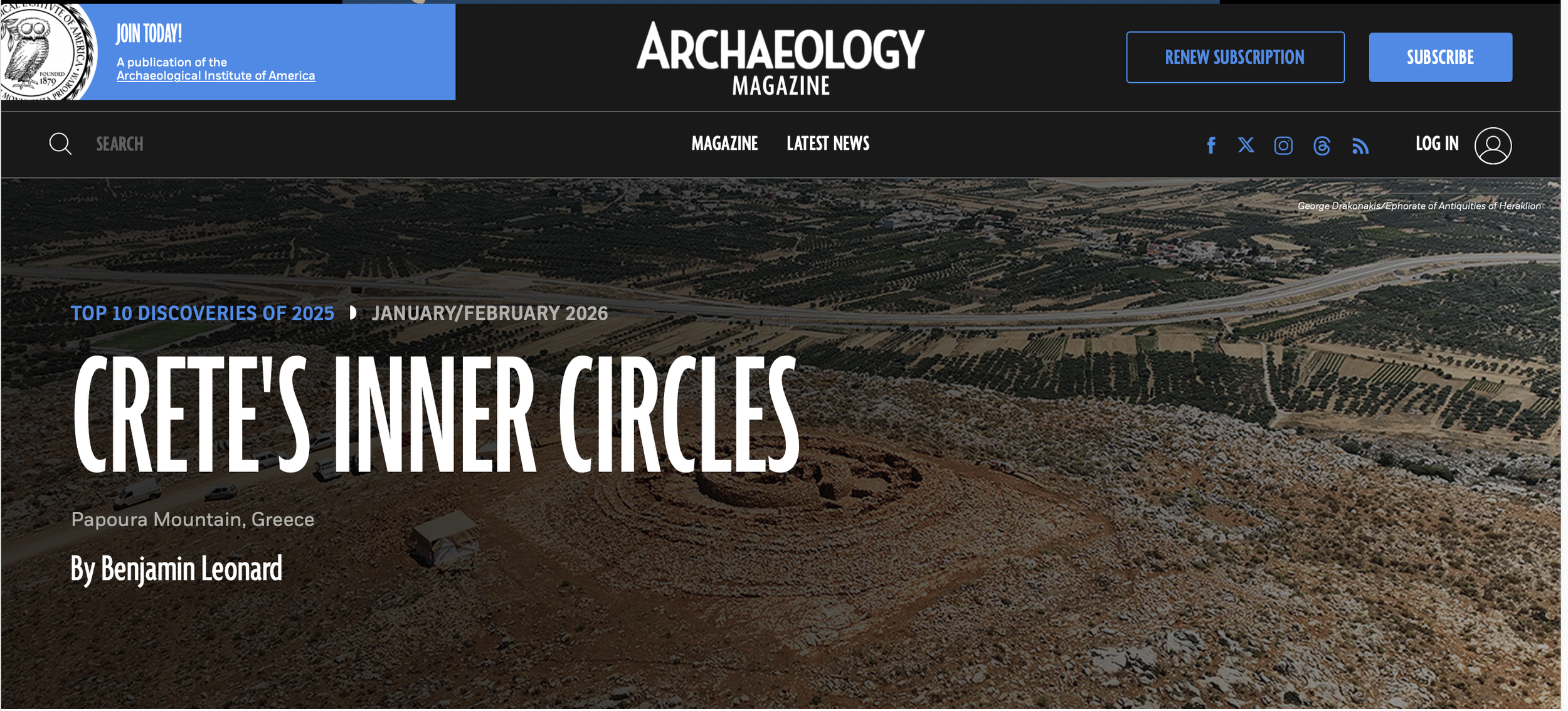
What do you think about New Year resolutions? I personally prefer wishes, both over the holidays and beyond. Indeed, in the Newsletter of September, I shared a specific wish while drawing you attention to an important archaeological discovery made in Crete, namely the prehistoric circular monument of Papoura. As I noted, “I personally hope that it will be included in the top-10 discoveries of 2025 by AIA’s Archaeology Magazine.” And the wish came true! Maybe I should have wished for something else, but I do care a lot about the archaeology of that area, and I am concerned by the threat posed by development of infrastructure adjacent to the monument of Papoura, which was recently problematized by National Geographic.
Our two scholarships programs continue to promote the interest of undergraduate and graduate students in archaeology and to attract them to the AIA. I had the pleasure of meeting the 7th cohort of the AIA-NYS Scholars Program, which includes students who represent different academic institutions around the city. The photo shows two members of this cohort, Ainsley Gillespie and Julia Kiaer, together with our December speaker, Professor Eleni Hasaki, as well as Dr. Joanne Spurza, my Vice-President and our host at Hunter College, and myself. By attending lectures and joining the speakers for dinner, our scholars get an opportunity for academic socializing, which is intended to promote their professional networking. It has been a gratifying experience to watch these students – who make up the next generation of archaeologists – to discuss with our distinguished speakers, and receive feedback on their ideas.
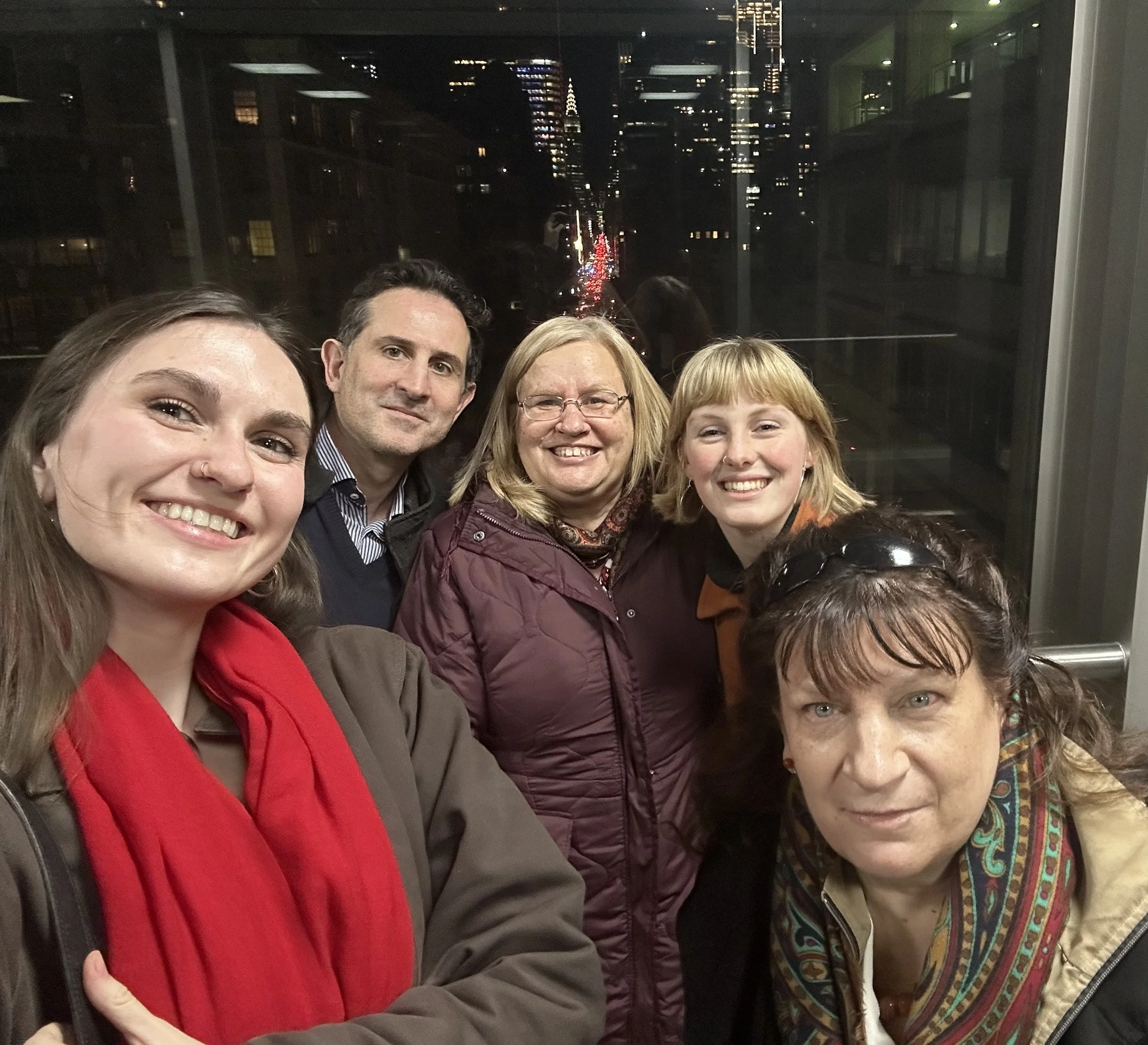
Left to right: Ainsley Gillespie, Antonis Kotsonas, Eleni Hasaki, Julia Kiaer, Joanne Spurza
The second scholarship program of our society, which is centered on a partnership with the Metropolitan Chapter of the New York State Archaeological Association, is only in its second year. However, it is yielding great results, as you can read in the exciting report of our first scholarship recipient, Miriam Entin, below! I take this opportunity to thank John Yarmick, my Board member who spearheaded the establishment of this fellowship. A long-time Treasurer of our Society and member of our Board, John has recently stepped down, and I take this opportunity to thank him profusely for his great service!
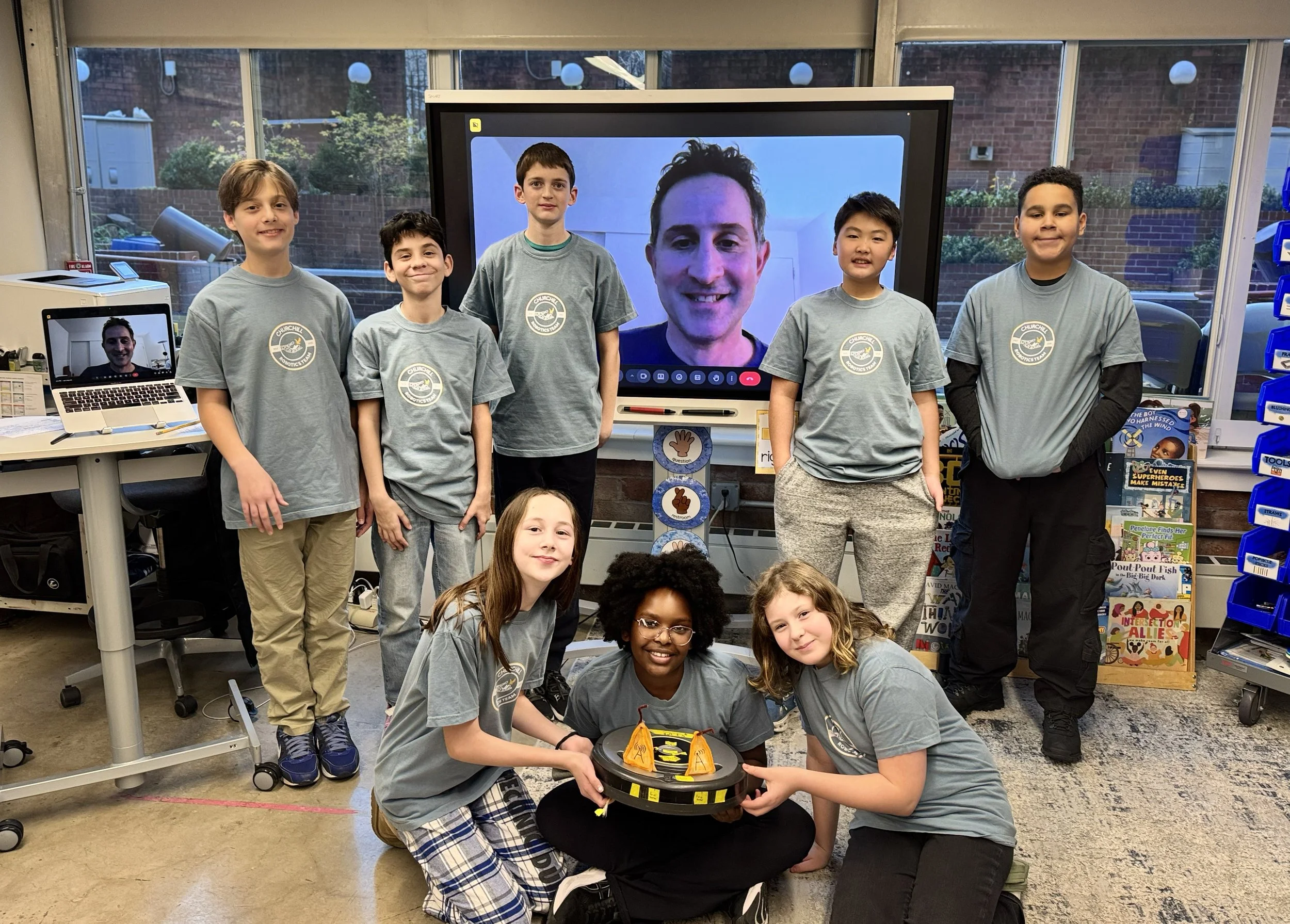
Antonis Kotsonas with the Churchill Hawks robotic team
Over the last few months, the Board of the AIA–NYS has conducted outreach to school students involved in the archaeology-focused 2025-2026 FIRST® LEGO® League UNEARTHEDTM . Indeed, we received a good number of requests from middle school classes and robotics teams from around the city for advice on the ideas and projects they developed for this competition. In response to this, I asked a good number of my board members to respond to specific requests, and I was happy to meet two different groups online. In the photo you can see me in company of the Churchill Hawks, from the Churchill School, who are proudly showcasing the model they created for the competition! The creativity and enthusiasm of these students and the ambitious projects they brought to the table were a revelation! I was also impressed by how professionally they choreographed their presentations, while they maintained the lovely attitudes of kids their age. They were curious about the technological resources available for archaeological fieldwork, the challenges that we, field archaeologists, face and the needs we have. Additionally, they were grateful to receive feedback on the projects they were developing, and they were quick to brainstorm on revisions and upgrades! Thus, I was happy – albeit not surprised to hear – that the Churchill Hawks moved forward in the competition with a golden ticket! I wish them and the other teams good luck with their projects, and I hope that this fun activity will mark the beginning of their long-lasting passion for archaeology!
What better way to cultivate this passion than by joining the New York Society of the Archaeological Institute of America? To its members, the AIA is a gateway to many opportunities in the world of archaeology. In turn, their membership supports archaeological research around the world! So please renew your membership, consider becoming a member, and help us attract to the AIA anyone interested by forwarding this link or this Newsletter!
With regards,
Antonis Kotsonas
President of the AIA New York Society
Associate Professor of Mediterranean History and Archaeology
Institute for the Study of the Ancient World
New York University
SPRING LECTURE SERIES
February 17: Lecture by Kathryn Morgan
Beyond Midas: Towards an Archaeological History of Phrygia
6 PM, ISAW Lecture Hall, 15 E 84th St.
March 18: Lecture by Christina Halperin (Brush lecture)
Rewriting Narratives of Collapse: Recent Investigations at the Ancient Maya City of Ucanal, Guatemala
6 PM, Zoom
April 17: Lecture by John North Hopkins (postponed)
On Fortune’s Doorstep: A Newly Identified Republican Temple on the Quirinal Hill in Rome
3 PM, National Arts Club, 15 Gramercy Pk S
INTRODUCING OUR 2025-2026 AIA-NYS SCHOLARS (COHORT VII)
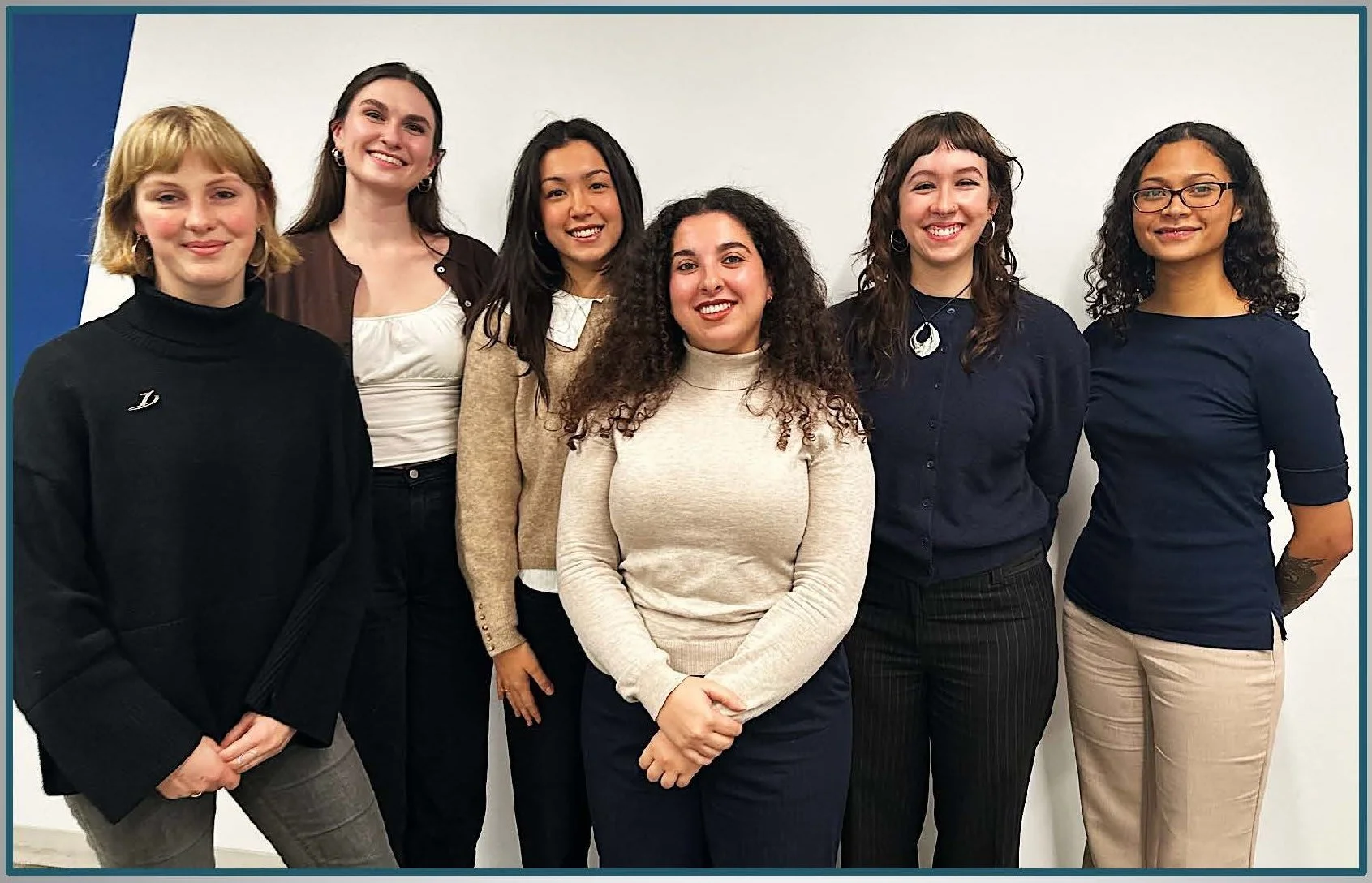
Left to right: Julia Kiaer (Barnard); Ainsley Gillespie (NYU); Vita Jackman Kuwarbara (NYU); Lauren Malkoun (ISAW-NYU);
Anna Selden (ISAW-NYU); Karina Osorio Klinger (Queens College)
The AIA-New York Society is pleased to introduce our newest cohort of Scholars. Our seventh cohort consists of six students from colleges and universities throughout the five boroughs. Our Scholars receive membership into the Archaeological Institute of America and a subscription to the American Journal of Archaeology and Archaeology magazine; they are invited to report on their archaeological work in our bi-annual Newsletter; and they attend various lecture-meetings of the AIA-NYS. Each Spring, members of this Scholars cohort are eligible to apply for a $1500 scholarship to support their participation in an excavation project, field school, or other archaeological research endeavor. Interested in applying to a future cohort? Please visit our website.
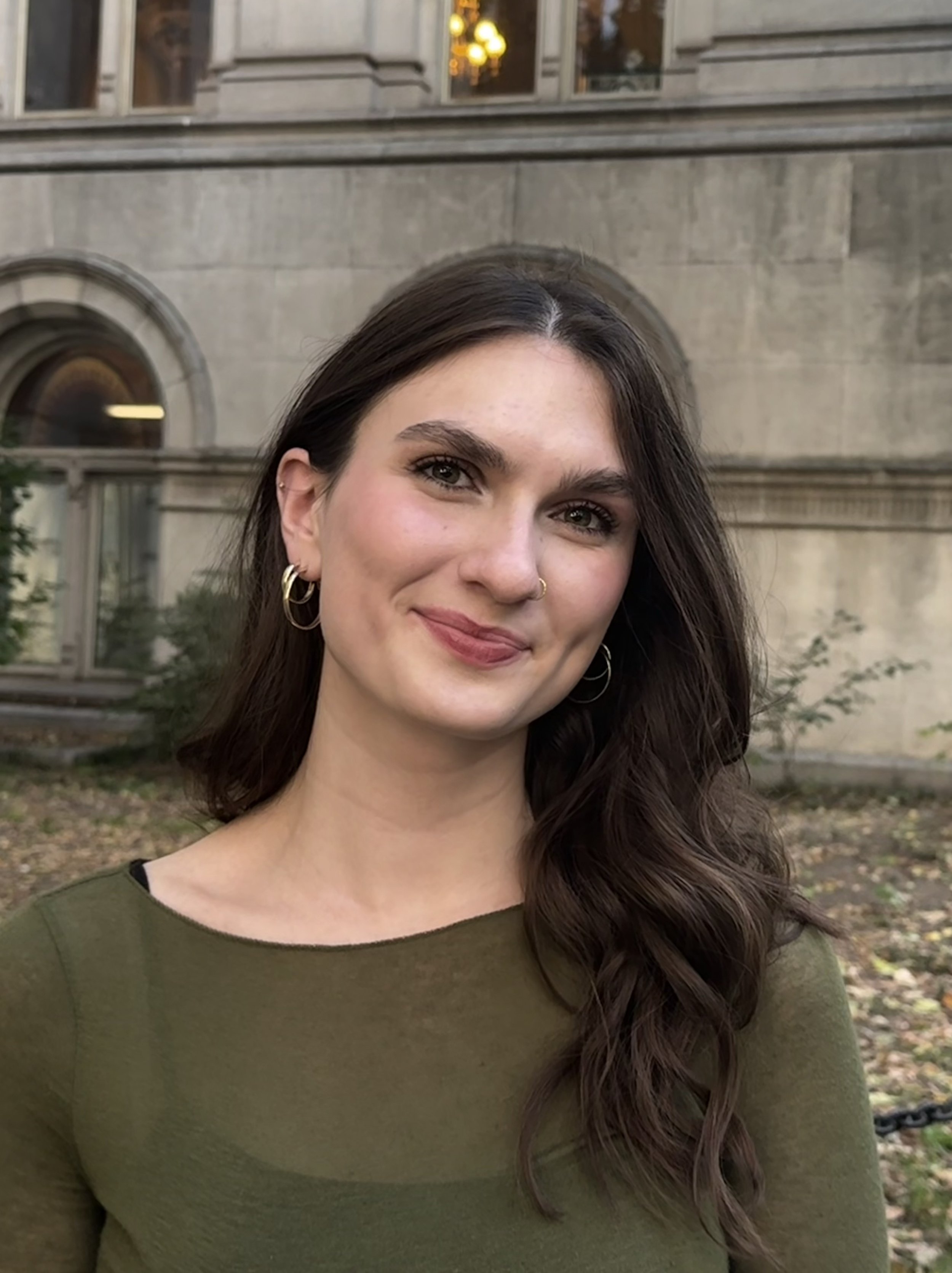
Ainsley Gillespie, NYU
Ainsley Gillespie is a sophomore studying anthropological archaeology at New York University. She works as a research assistant in the Department of Anthropology’s new Historical Ecology and Human Landscapes lab, which focuses on reconstructing past environments and human response to climate change through geoarchaeological and microbotanical analysis. She is particularly interested in the ethics of archaeology and the “curation crisis” and hopes to pursue an M.A. in museum studies to further her passion for accessible and responsible curation practices.
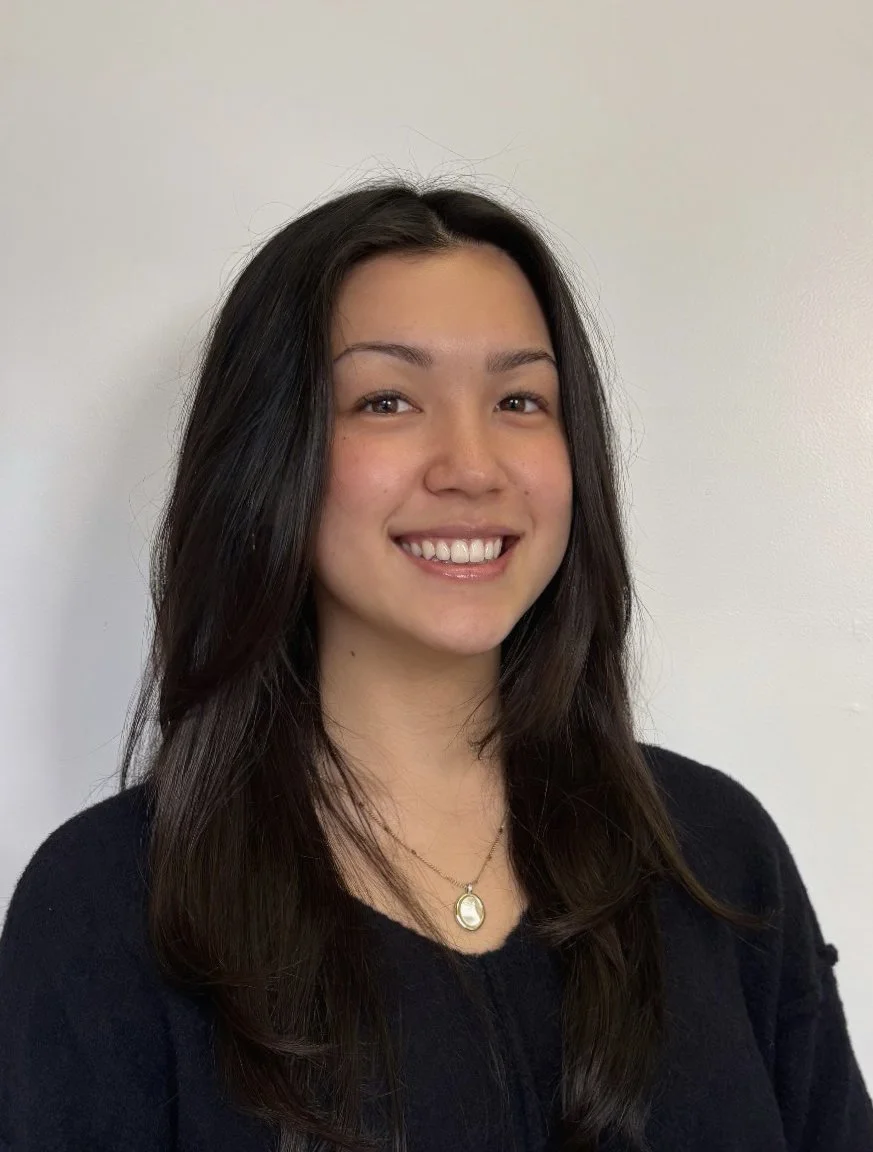
Vita Jackman Kuwabara, NYU
Vita Jackman Kuwabara is a senior undergraduate in NYU’s Anthropology honors program, with minors in Archaeology and Politics. She has excavated at an Iron Age settlement in Portugal and recently completed a field season at two Paleolithic caves in southern Kazakhstan, alongside assisting ongoing lithic use-wear analysis research in the Anthrotopography Lab at the Center for the Study of Human Origins (CSHO). She is excited to continue developing her interests in prehistoric archaeology, human–environment relationships, and cultural heritage as she prepares for future graduate studies.
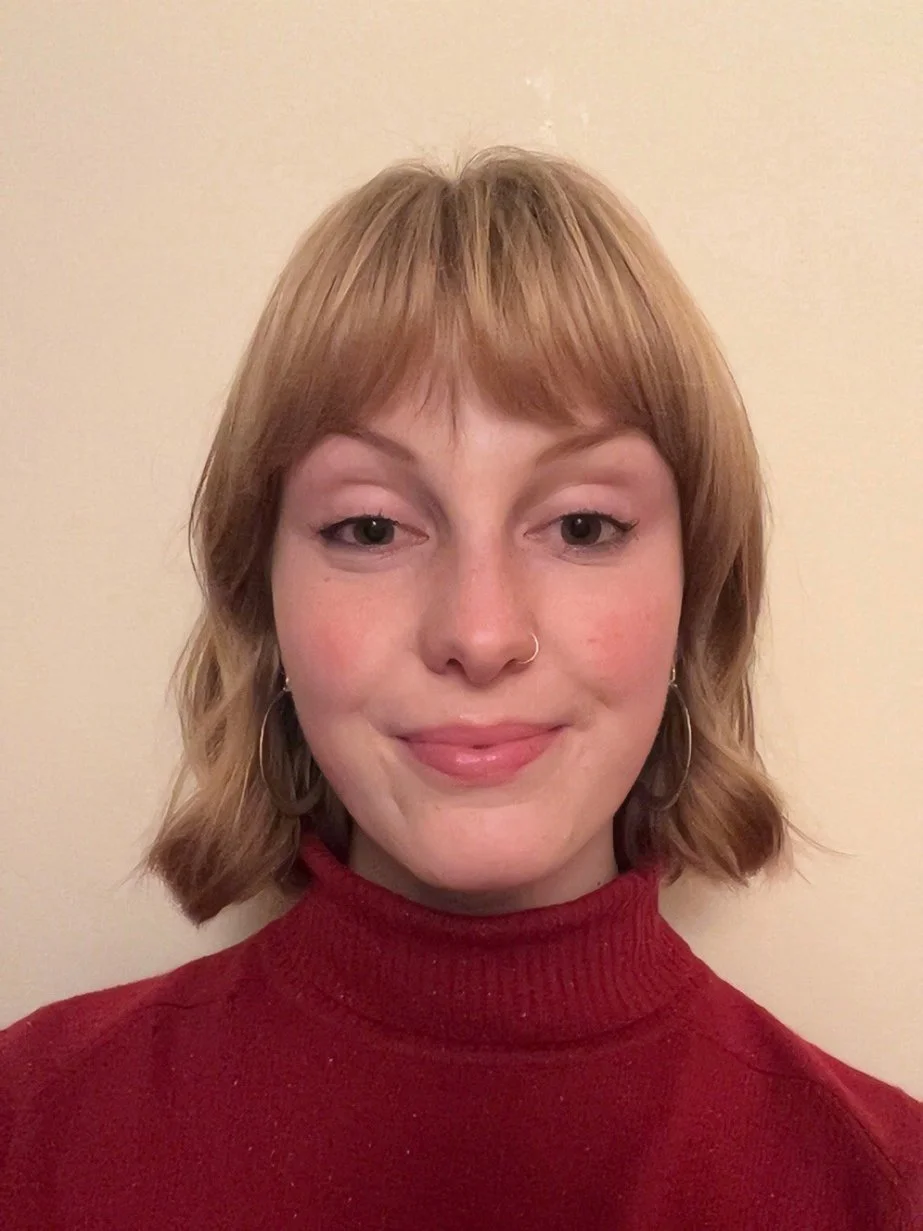
Julia Kiaer, Barnard
Julia Kiaer is a senior at Barnard College studying archaeology and creative writing. She is originally from Portland, Oregon, and has done excavation and lab work in New Mexico, Peru, Norway, and New York City. She plans to pursue a graduate education in archaeology after graduation.
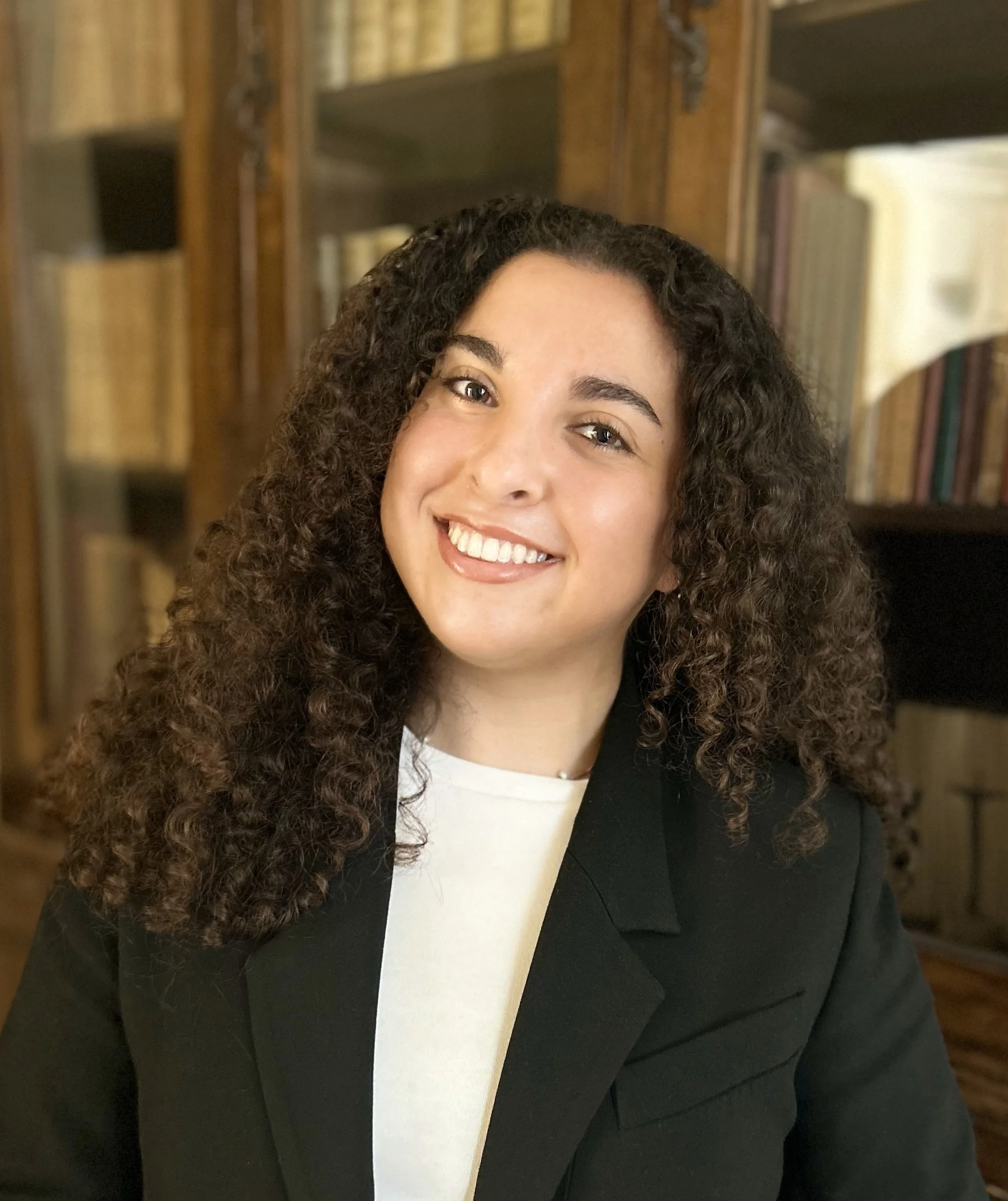
Lauren Malkoun, ISAW-NYU
Lauren Malkoun is a first-generation Lebanese-American PhD student at the NYU Institute for the Study of the Ancient World where she is specializing in the archaeology of the eastern provinces of the Roman Empire. She received her masters in Mediterranean Archaeology from Sapienza University of Rome (2025) and a B.A. in Archaeology and a B.A. in Italian from the University of Southern California (2023). Lauren has excavated in Menorca and Carrascosa (Castilla La Mancha), Spain; at Pompeii, Italy; at the Athenian Agora in Athens, Greece; and on the Palatine Hill in Rome, Italy. Her research interests regard Mediterranean networks, landscape archaeology, digital humanities, post-colonialism, and heritage preservation.
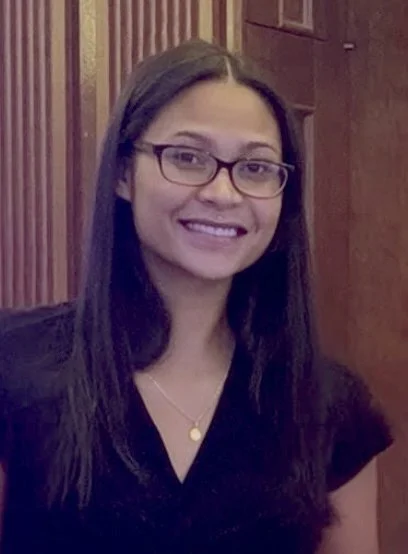
Karina Osorio-Klinger, Queens College
Karina Osorio-Klinger is a senior at Queens College majoring in Anthropology. Her research interests are landscapes, ceremonial architecture, and the Maya Preclassic period.
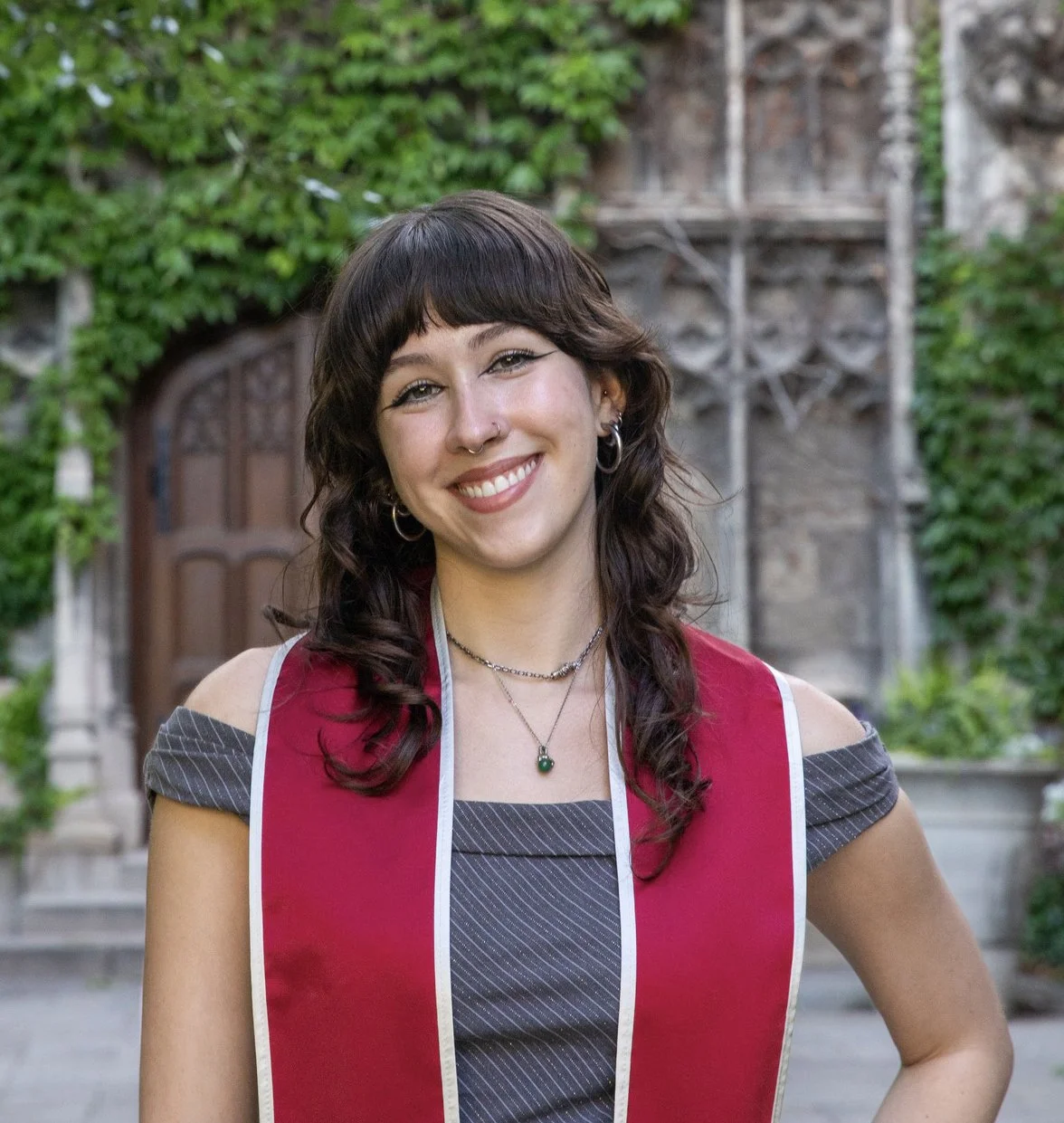
Anna Selden, ISAW-NYU
Anna Selden is a first-year PhD student at the Institute for the Study of the Ancient World at New York University. Her research focuses on the visual culture of the Aegean, Anatolia, and Mesopotamia in the first millennium BCE, particularly through the themes of gender, the body, and dress in figural representations. She has excavated at Tell Keisan, Cerro del Villar, and Lyktos Archaeological Project. She hopes to further investigate the identity of eunuch priests in the Eastern Mediterranean through art historical, archaeological, and textual lenses.
FIELD REPORTS
EXCAVATING in DIXON, NEW MEXICO
Julia Kiaer
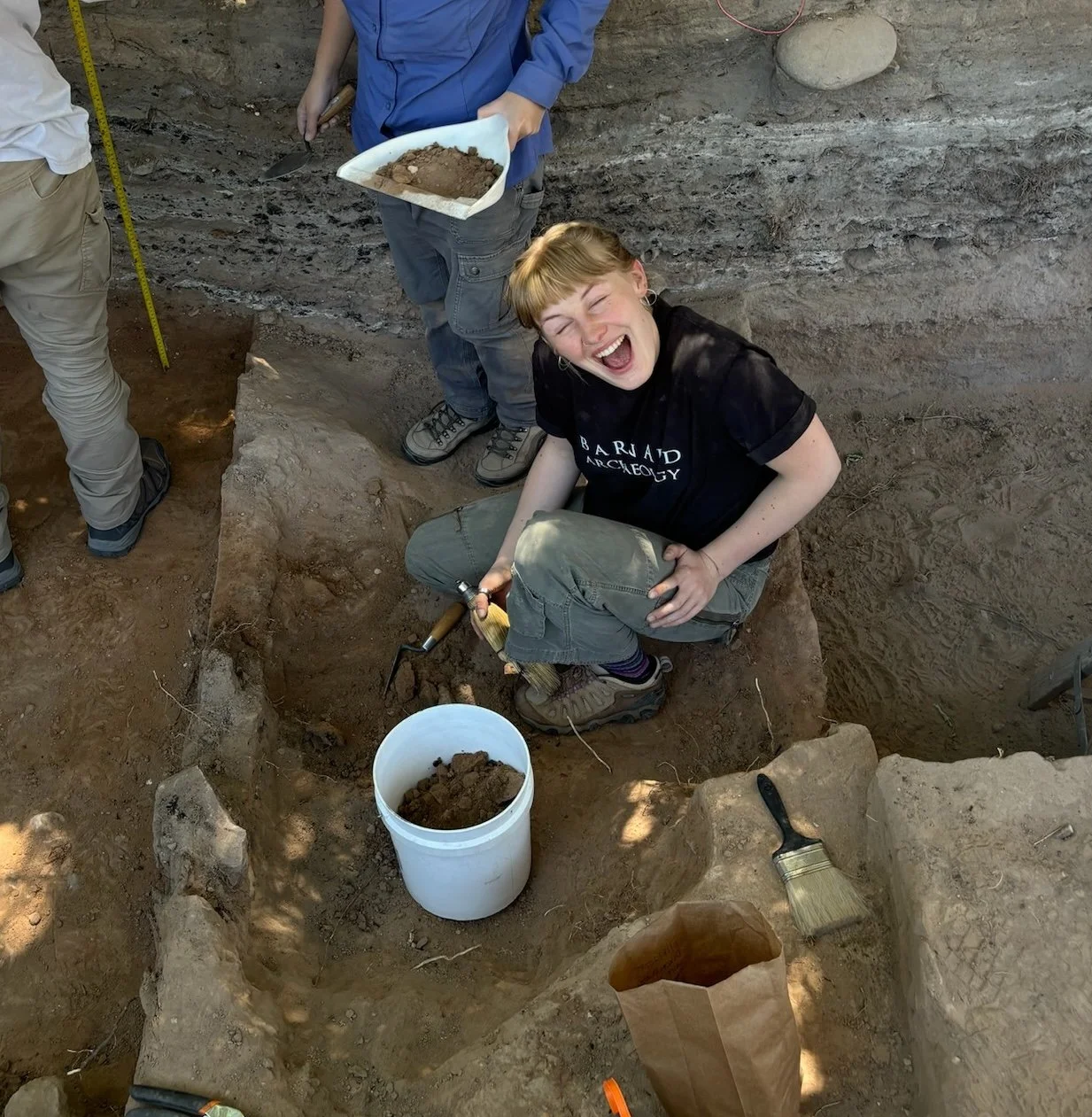
Julia excavating in a pit feature on the historic Embudo Plaza in Dixon, New Mexico.
Julia Kiaer spent the fall working in the Columbia Center for Archaeology’s lab where she analyzed material she helped excavate last summer in Dixon, New Mexico, under the direction of Barnard College Professor Severin Fowles. Excavations were conducted on the historic plaza as part of a community acknowledgement of the tercentenary of the San Antonio del Embudo land grant which established the Indo-Hispano town in 1725. The town was intended to serve as a buffer for the Spanish empire against Comanche raiding throughout the 18th century. Lab analysis of ceramics and faunal remains revealed an interconnected history of Spanish colonial and Indigenous occupation at the site. Artifacts like sherds worked into game pieces, awls made of goat horn, and Cracker Jack toys elucidated the multipurpose, multigenerational, and adaptive life ways of the plaza space. She and a team of Barnard archaeologists presented a full report of the site to community members in December. This was Julia’s second time excavating in northern New Mexico and after graduating in May she plans to return for another season!
FIELDWORK on the PALATINE HILL and UMBRIA
Lauren Malkoun
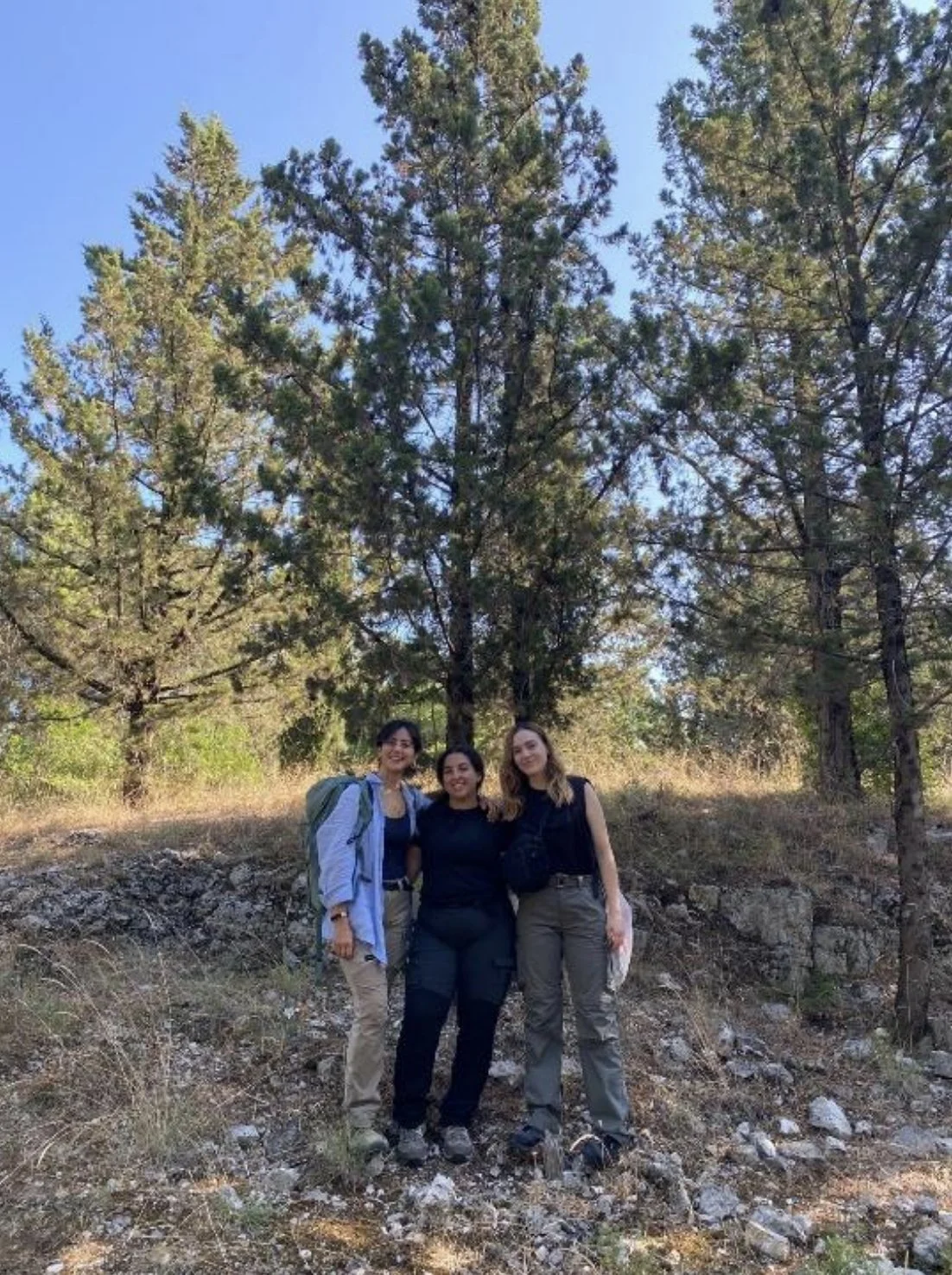
Summer 2025 surveys in Umbria: L. Malkoun in center
Looking ahead to an exciting field season for 2026 and trying to survive a very cold winter in the city, I see it a fitting time to reminisce and account my most recent fieldwork. For the past two years, my active and ongoing fieldwork has been targeted towards Roman archaeology. During the summer of 2024, I participated in excavations on the southern slope of the Palatine Hill. These excavations, led by Professor Paolo Carafa, were concentrated on the House of Augustus. The work specifically targeted the area under what is already known as the emperor’s residence to identify the exact position and extension of Augustus’ villa-sanctuary. Within this context, I excavated, documented stratigraphy, and rotated with my peers to wash and study the ceramics that were coming from our trench on the southern slope. I also took part in documenting wall stratigraphy of a previously excavated sector of the southern slope. Documenting this stratigraphy required drawing walls to scale and noticing the different building techniques in order to establish some sort of potential order as to which the structure could have taken form. Such an exercise made me actively think of the structures all around us today in a new light. This practice also demonstrated to me the complexities of ancient cities, such as but not limited to Rome, which are complex in their continuous inhabitance for millennia during which different periods see different phases of buildings and speak to wider societal shifts, changes, or trends. Shortly after we closed the excavation season, these skills aided me greatly in my master’s thesis in which I made a 2D architectural reconstruction of a domus in Pompeii. These excavations by “La Sapienza” University of Rome are ongoing, and so my vague account will hopefully encourage you to look at the most recent publications by this team and also the Instagram page that documents their ongoing research.
Following this season of excavation and prior to defending my master’s thesis and graduating from “La Sapienza” University of Rome, I was involved in the laboratory work to properly organize and process the excavation documentation, stratigraphy, and data. I gained experience in creating a Harris Matrix, which provides a visual aid as to how the various stratigraphic layers defined within our trench interacted with each other. This documentation is important not only for later analyses of the site but also must be sent to the Soprintendenza. Being part of this excavation season not only during the “physical” or “manual labor” portion but also for the following laboratory, provided me with the opportunity to work with and process what I personally had excavated and see things through to the true end of a season. Furthermore, I saw first-hand the importance of detailed and clear notes. Not only are these descriptions and notes useful for the team working on the materials immediately after the season, but this methodology is vital for future generations within the discipline who may return to such documentation for theses, articles, and the like.
After defending my thesis in July, I began working on a new project regarding ancient Umbria. In August of 2025, as part of this project, I participated in surveys in Umbria with particular attention to peak sanctuaries. This required hiking up to these various peaks of southern Umbria, measuring out grids, and lots of looking down with hopes of seeing a ceramic sherd. My colleagues and I are now in process of publishing an account of the surveys and research done. As I finalize my plans for this upcoming season, I look forward to returning to Umbria for at least a few weeks this summer to continue our work.
FIELDWORK in NYC and GUATEMALA
Karina Osorio-Klinger
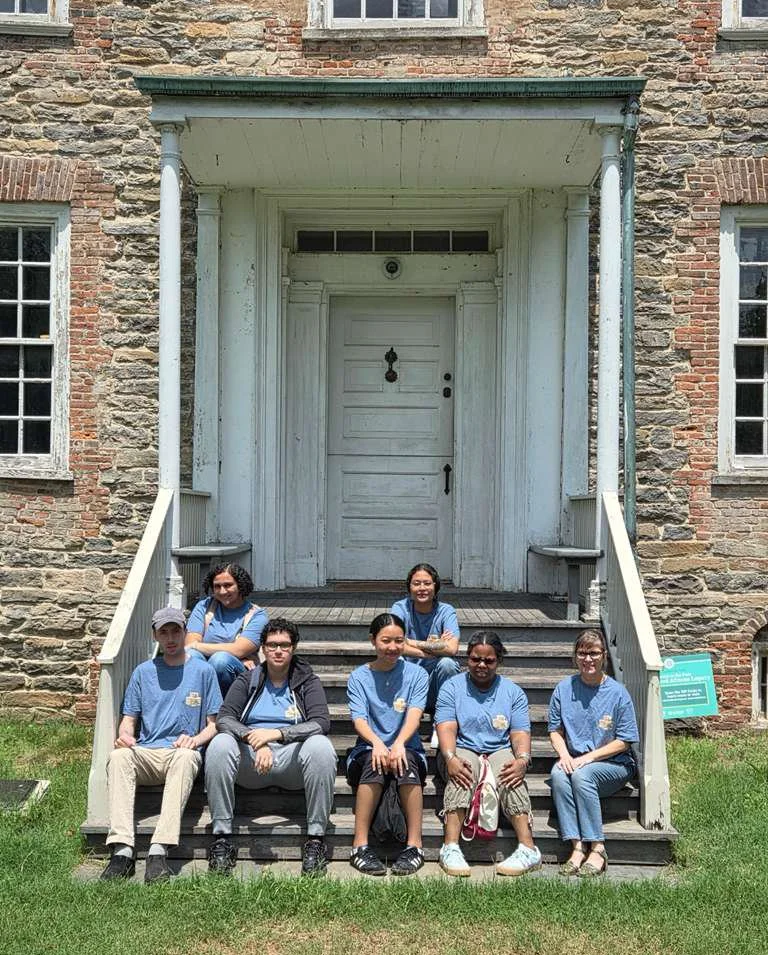
Class and Dr. Britt in front of Van Cortlandt House Museum
In June 2025, I enrolled in a Field Methods in Archaeology course at Brooklyn College, supervised by Dr. Kelly Britt. This class was an excellent deep dive into historical archaeology in New York City, with a focus on Van Cortlandt Park. We had the opportunity to work closely with the Van Cortlandt Park collections, such as cleaning, cataloguing, and photographing artifacts, as well as writing and presenting an artifact biography for our final project. We analyzed glass bottles and shards, porcelain and stoneware ceramics, buttons, and oyster shells. We worked closely with archived material such as digitized USGS topographic maps and field reports from the 1990-1992 season excavations at Brooklyn College.
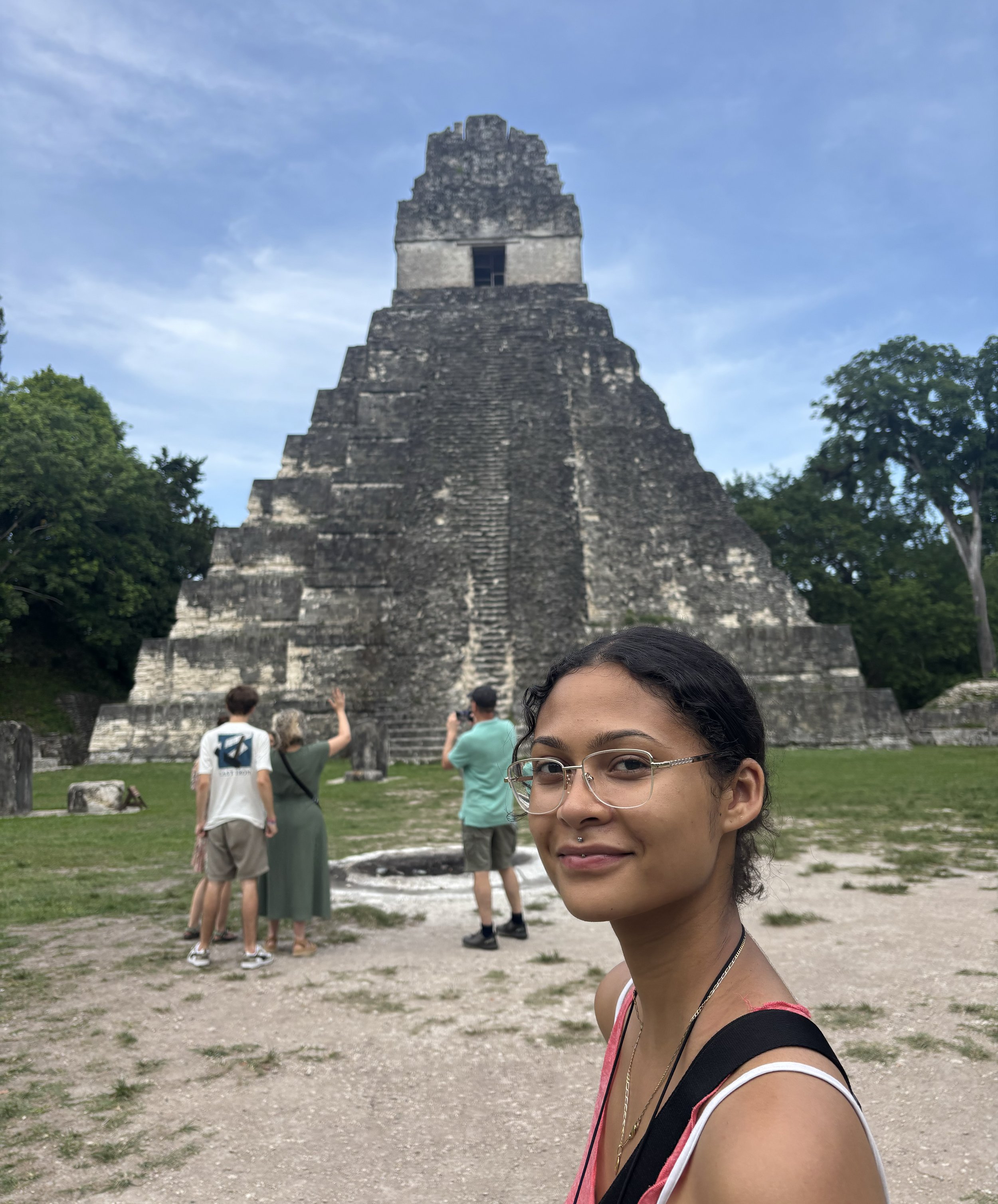
Standing in front of Temple 1 at Tikal
In July 2025 I traveled to Petén, Guatemala to work with artifacts from the collections of Proyecto Itza supervised by Dr. Timothy Pugh. I received hands-on training on identifying Preclassic Maya (1000 BC-AD 200) ceramics, incense burners, and figurines, based on their material composition and surface details. I also visited some Preclassic sites such as Tayasal, Paxcaman, and Tikal, to examine architectural layouts and constructions such as E Groups and Triadic Groups. These are ceremonial architectural complexes which emerged in the Preclassic period. Many early archaeologists believe they acted as solar observatories of solstices and equinoxes, but new data suggests that most were not perfectly oriented to do so. My undergraduate honors thesis at Queens college focuses on E Groups. This thesis investigates Bijo, a probable Late Preclassic period (300 BC-AD 200) Maya capital. I incorporated lidar data from Bijo and the surrounding area, which I processed and analyzed in Surfer software, to reconstruct the architecture and prominent features of this site and to examine settlement patterns and their distribution. This project aims to investigate how social identity is intertwined with monumental constructions in the landscapes of the Late Preclassic period and the subsequent abandonment of major sites, many of which were centrally organized around E Groups.
LYKTOS ARCHAEOLOGICAL PROJECT - CENTRAL CRETE
Anna Selden
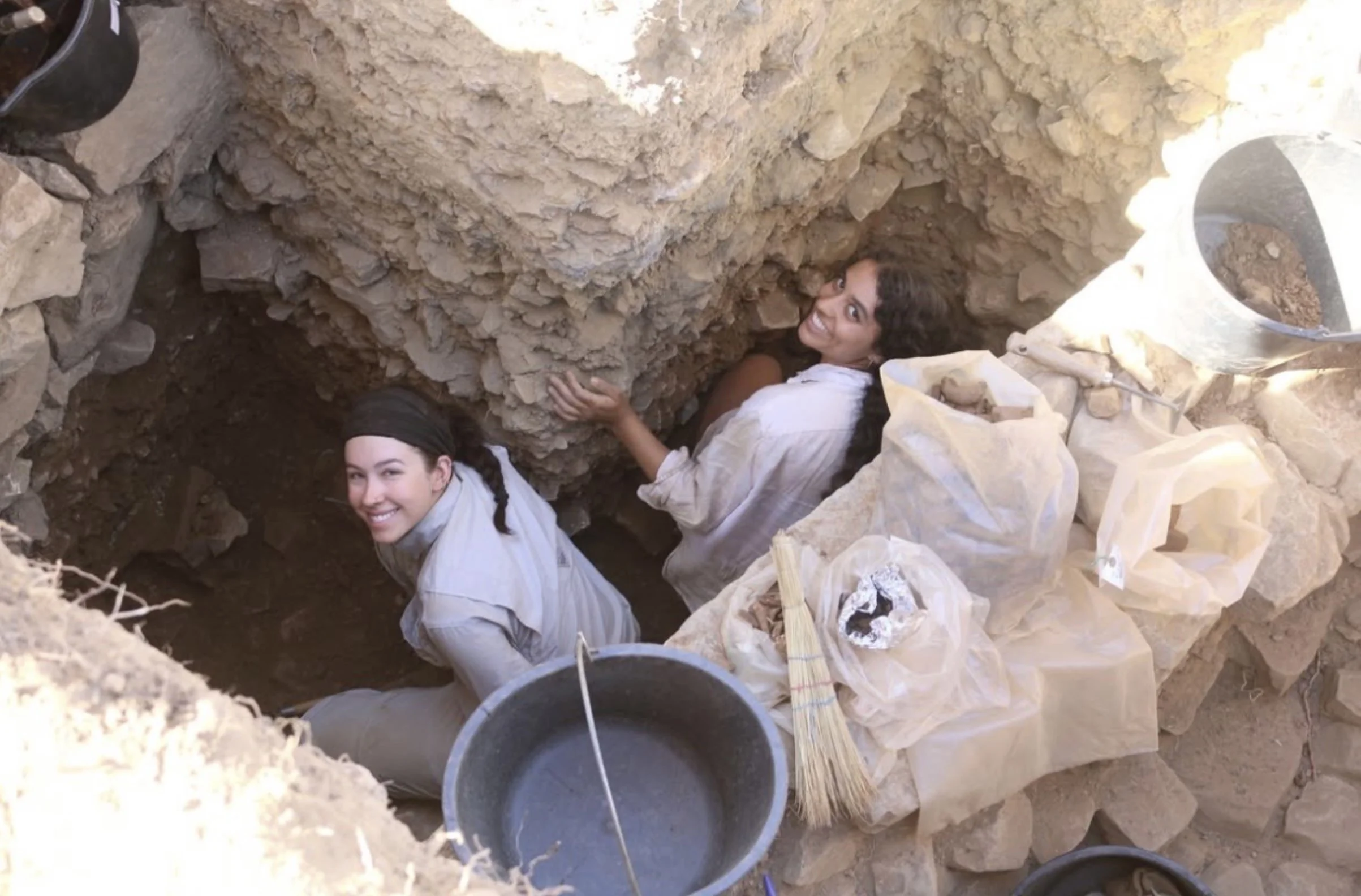
Anna Selden (L) and 2024-25 AIA-NYS Scholar Siena Cohen-Parikh (R) in one of the trenches at Lyktos Sector A
In summer 2025, I served as a trench supervisor for Lyktos Archaeological Project in central Crete. Co-directed by Professor Antonis Kotsonas (ISAW/NYU), Professor Angelos Chaniotis (Princeton), and Dr. Vasiliki Sythiakaki (Greek Archaeological Service), the project interrogates the Greek, Roman, and Byzantine structures and material at the site. As a part of the ISAW/NYU team, our work focused on Iron Age and Archaic period layers. Collaborating with an international team of excavators and specialists, our team contributed to the project through our diverse and interdisciplinary academic backgrounds. This was my first time working as a trench supervisor, which provided in-depth experience in recording data in the field and maintaining a written report of the trench’s progress during the season. Early in the excavation process after opening a new trench, my trench revealed Roman structures, helping to clarify its relationship to the other areas of Sector A and the Roman building complex at Lyktos Sector B. I particularly enjoyed articulating the stones in the newly revealed walls. Also exciting for me was my first time seeing Attic pottery sherds in the field, with their distinctive rich red color that I had so often admired behind the glass of museum displays. On the weekends, the excavation team went on excursions to significant Cretan archaeological sites, including Knossos, Syme Viannou, and Azoria, along with visits to the beach! Overall, excavating at Lyktos built on my previous excavation experience at Phoenician sites in the Mediterranean and allowed me to grow my knowledge of Cretan and Aegean material culture.
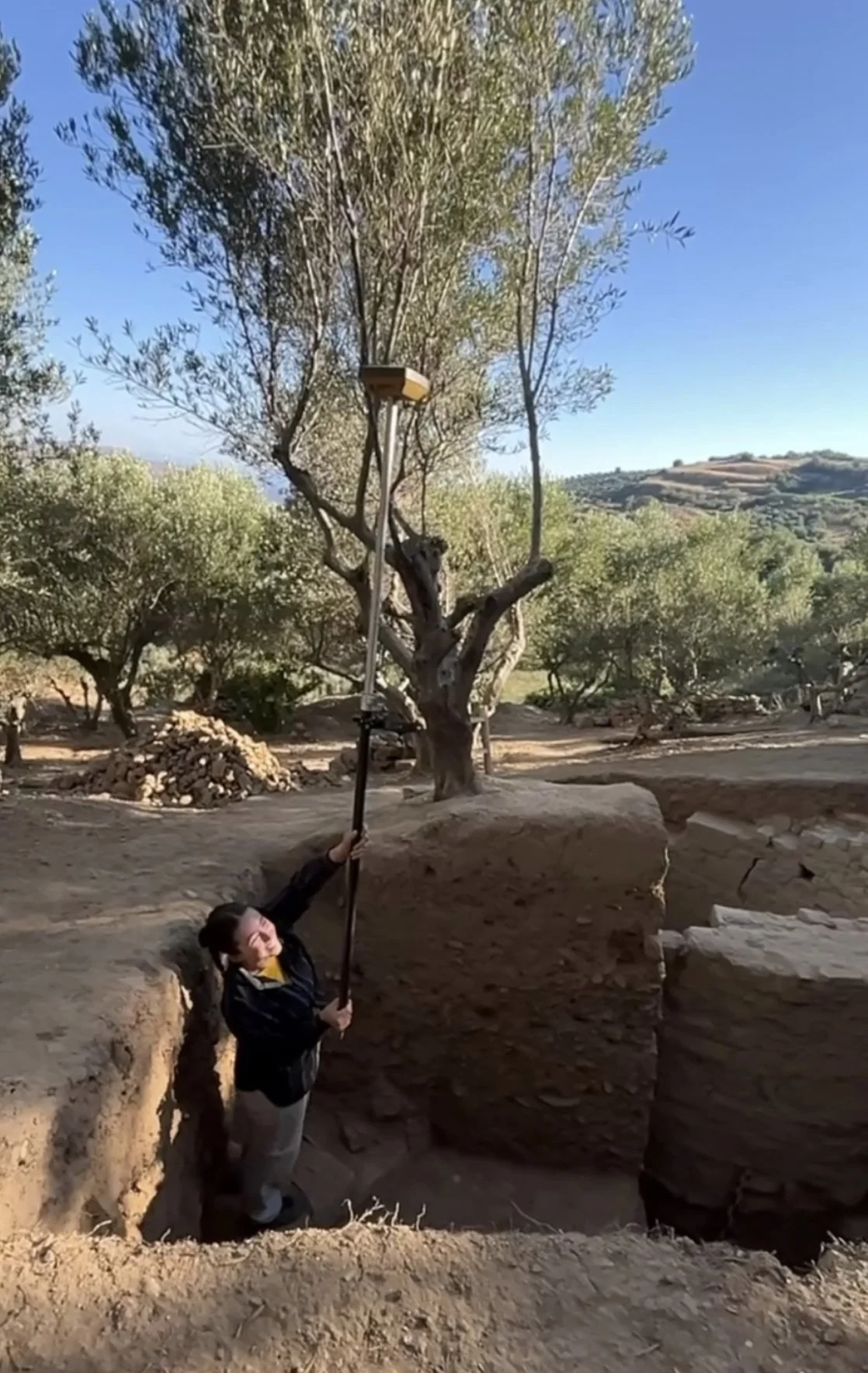
Anna getting a signal on the GPS to help take elevation points at Lyktos Sector A
ANNOUNCING THE WINNER OF OUR JOINT SCHOLARSHIP SUPPORTING RESEARCH
ON NEW YORK CITY-BASED ARCHAEOLOGY
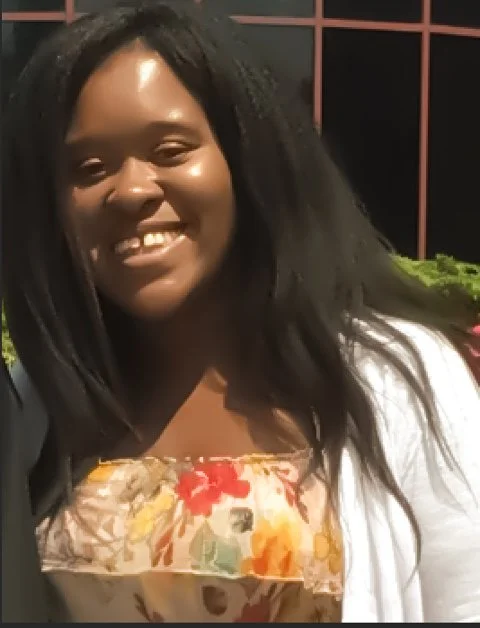
Kerri Matthews, NYU
In this newsletter you will find an article by Miriam Entin on Jewish ritual baths in New York City during the period of mass Eastern European Jewish immigration between 1880 and 1920, the subject of her dissertation. Miriam, who is a PhD Candidate at the CUNY Graduate Center, was able to advance her dissertation research thanks in part to receiving a year ago the first scholarship awarded jointly by the AIA New York Society and the Metropolitan Chapter of the New York State Archaeological Association. Miriam will also be providing the Society with a briefing on her research at our public lecture scheduled for February 17, 2026. We are looking forward to that.
We are now pleased to announce the second recipient of this joint scholarship, Kerri Matthews, a Graduate student at New York University. Kerri has been doing research on the faunal remains from four city excavations. This scholarship will help fund a public archaeology outreach program to introduce zoo-archaaeology to NYC public schools to teach students how archaeologists use animal bones to uncover past diets. Congratulations to Kerri on receiving this scholarship. We will welcome her report a year from now.
This $1,500 joint scholarship is offered each year to an undergraduate or graduate student enrolled in an accredited North American university who is preparing a thesis or doctoral dissertation or is engaged in independent research connected to the student’s academic studies, as long as the research encompasses or includes elements of New York City archaeological findings. It is intended to support the costs associated with conducting the research.
Each fall interested and eligible students are invited to submit an application that includes a narrative description of the project, an anticipated budget, a transcript and a letter of endorsement by their professor or faculty advisor.
The scholarship program is administered and overseen by both organizations working in collaboration. The recipient is chosen by a committee comprised of four academic board members — two from the AIA New York Society and two from the NYSAA Metropolitan Chapter. The scholarship is funded in part by the generosity of the Friends of the AIA New York Society.
DISSERTATION RESEARCH on MIKVA’OT
Miriam Entin, recipient of the AIANYS-NYSAA Joint Scholarship, 2025
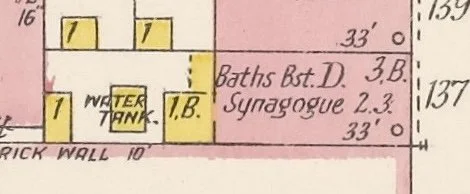
With the support of the joint AIA-NYS / NYSAA scholarship, I advanced my dissertation research on Jewish ritual baths (mikva’ot) in New York City during the period of mass Eastern European Jewish immigration between 1880 and 1920. My work has focused on identifying the locations and distribution of mikva’ot that emerged during this major wave of Jewish migration to the United States and situating them within the rapidly changing urban landscape of NYC.
Using a combination of archaeological documentation and advertisements published in Yiddish- language periodicals, I have so far identified 38 mikva’ot that operated in NYC during this period. Archaeological site reports provide material and spatial data for a small number of these sites, while newspaper advertisements offer critical evidence for the existence, services, and locations of many others that are no longer archaeologically visible. To further support the identification of each mikvah, I systematically plotted all 38 locations using fire insurance maps produced between 1850 and 1950. These maps allowed me to confirm each mikvah’s presence at a specific address, document visual property markers associated with bathhouse use, establish approximate opening and closing dates, and assess the potential for future archaeological investigation at each site.
Together, these sources allow for a more comprehensive reconstruction of the mikvah landscape than any single body of evidence could provide on its own. This growing dataset will form the basis for analyzing broader trends in mikvah practice and usage, including issues of water access, sanitation, and overcrowding, as well as possible commonalities with Russian–Turkish bathhouse traditions. It also provides a way to track shifts in the immigrant Jewish population within NYC over time, as neighborhoods changed and communities relocated.
I am very grateful to the AIA-NYS and the Metropolitan Chapter of the NYSAA for their generous support. This scholarship made it possible to carry out focused archival and documentary research that has been central to the progress of my project.
Miriam Entin
PhD Candidate, Archaeological Anthropology
CUNY Graduate Center
FRIENDS of the AIA-NYS SPECIAL MORGAN LIBRARY TOUR
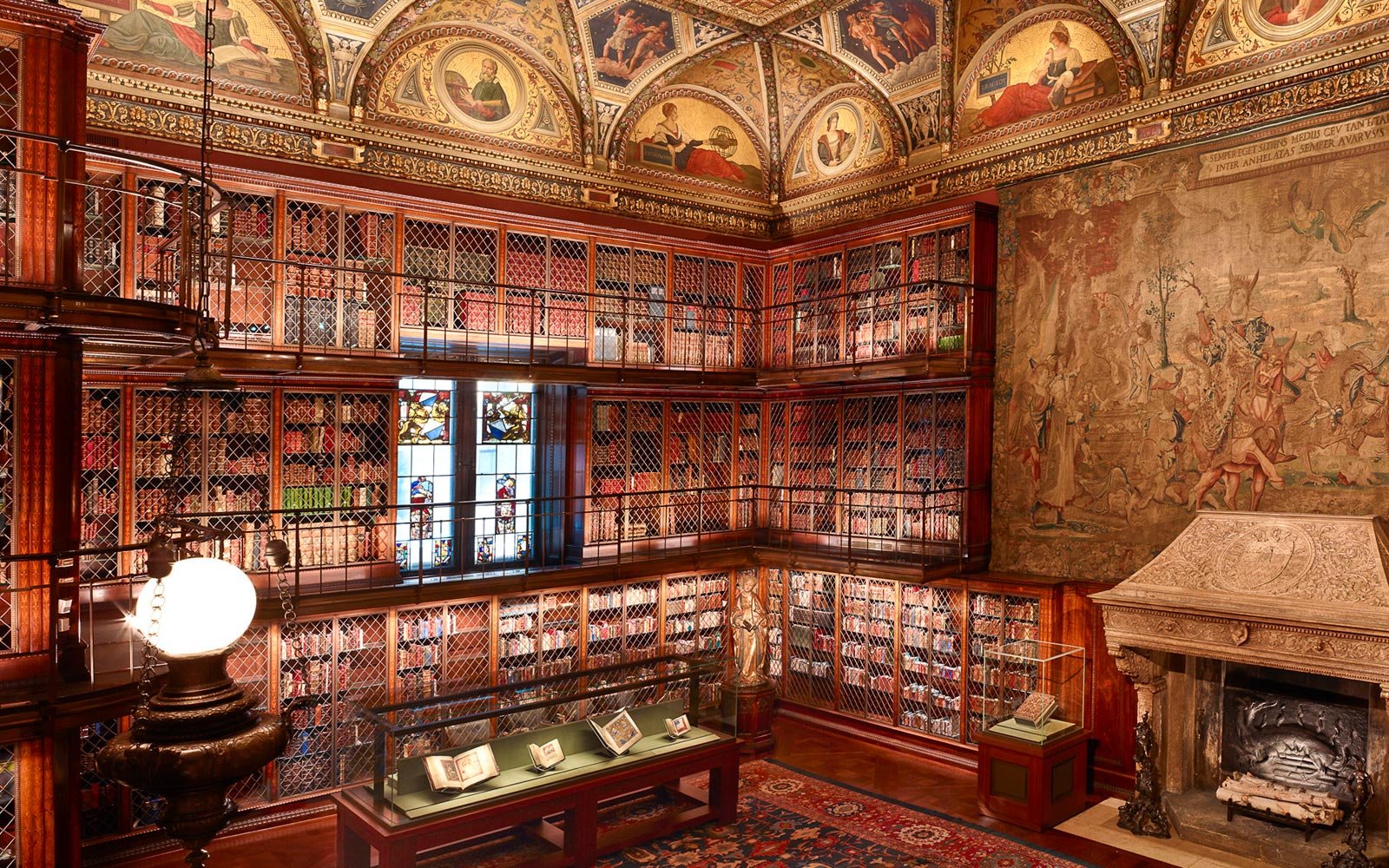
The Friends of the AIA-NYS are a small group of enthusiasts and professionals who go the extra mile to provide the New York Society with the ability to bring you the most extensive lecture program(s) in the AIA. As a bonus they have access to several private and intimate events such as guided tours of exhibits and lectures held in people’s homes. These are events where the Friends can gather in a small, informal setting to share knowledge, ask questions and enjoy making new friends with professional archaeologists and with those of similar interests.
If you are interested in joining Friends of the AIA-NYS, please fill out THIS FORM.
To inquire about joining the Friends please email Jason Earle. Our next event will be on March 4th, 2026, at the Morgan Library, where we’ll have a special tour of the Ancient Western Asian Seals and Tablets collection by Dr. Pinar Durgun, Associate Curator. It should be fun to explore this hidden gem!