
NOTES from the FIELD, 2025
FIELDWORK on the PALATINE HILL and UMBRIA
Lauren Malkoun
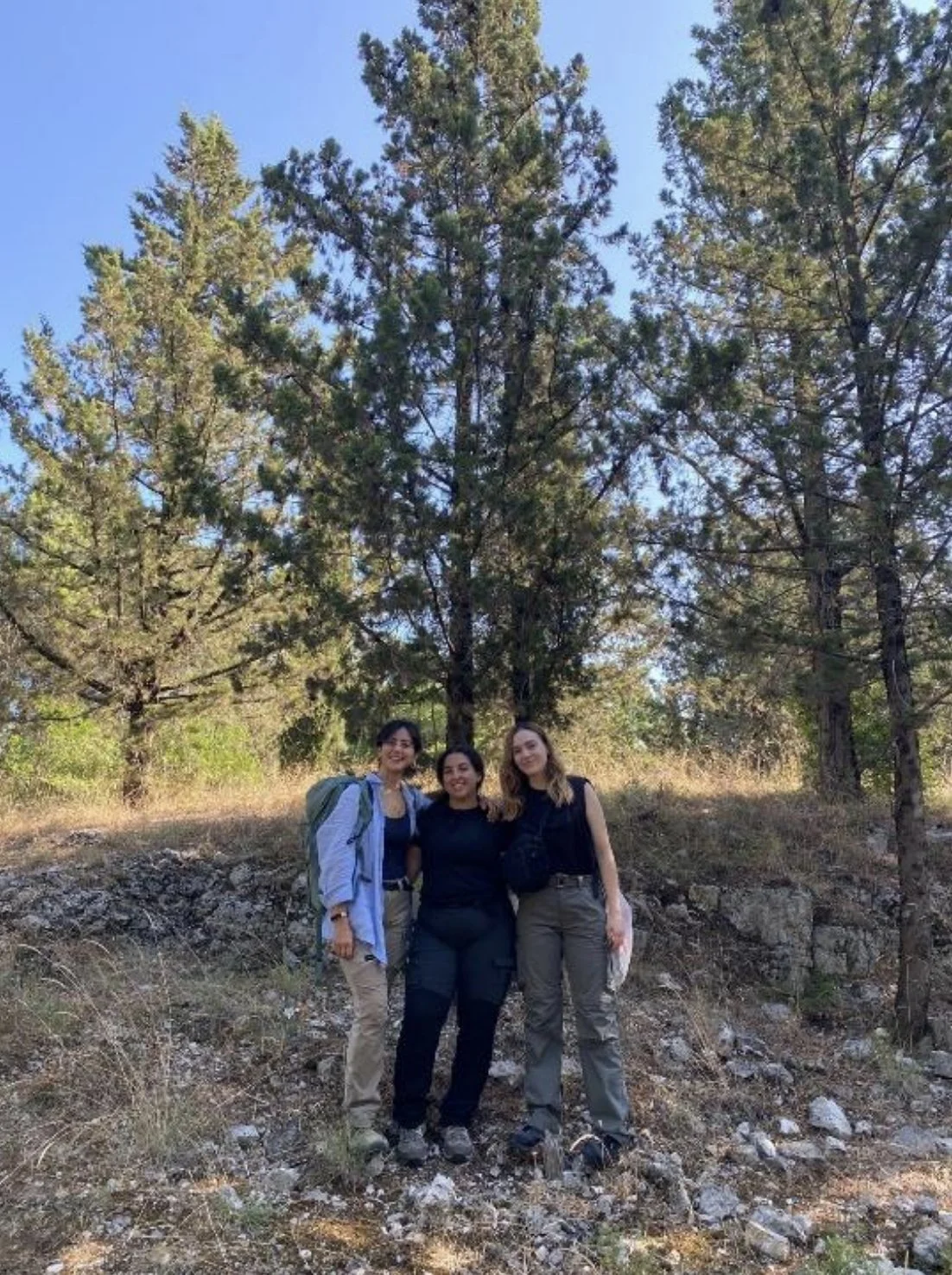
Summer 2025 surveys in Umbria: L. Malkoun in center
Looking ahead to an exciting field season for 2026 and trying to survive a very cold winter in the city, I see it a fitting time to reminisce and account my most recent fieldwork. For the past two years, my active and ongoing fieldwork has been targeted towards Roman archaeology. During the summer of 2024, I participated in excavations on the southern slope of the Palatine Hill. These excavations, led by Professor Paolo Carafa, were concentrated on the House of Augustus. The work specifically targeted the area under what is already known as the emperor’s residence to identify the exact position and extension of Augustus’ villa-sanctuary. Within this context, I excavated, documented stratigraphy, and rotated with my peers to wash and study the ceramics that were coming from our trench on the southern slope. I also took part in documenting wall stratigraphy of a previously excavated sector of the southern slope. Documenting this stratigraphy required drawing walls to scale and noticing the different building techniques in order to establish some sort of potential order as to which the structure could have taken form. Such an exercise made me actively think of the structures all around us today in a new light. This practice also demonstrated to me the complexities of ancient cities, such as but not limited to Rome, which are complex in their continuous inhabitance for millennia during which different periods see different phases of buildings and speak to wider societal shifts, changes, or trends. Shortly after we closed the excavation season, these skills aided me greatly in my master’s thesis in which I made a 2D architectural reconstruction of a domus in Pompeii. These excavations by “La Sapienza” University of Rome are ongoing, and so my vague account will hopefully encourage you to look at the most recent publications by this team and also the Instagram page that documents their ongoing research.
Following this season of excavation and prior to defending my master’s thesis and graduating from “La Sapienza” University of Rome, I was involved in the laboratory work to properly organize and process the excavation documentation, stratigraphy, and data. I gained experience in creating a Harris Matrix, which provides a visual aid as to how the various stratigraphic layers defined within our trench interacted with each other. This documentation is important not only for later analyses of the site but also must be sent to the Soprintendenza. Being part of this excavation season not only during the “physical” or “manual labor” portion but also for the following laboratory, provided me with the opportunity to work with and process what I personally had excavated and see things through to the true end of a season. Furthermore, I saw first-hand the importance of detailed and clear notes. Not only are these descriptions and notes useful for the team working on the materials immediately after the season, but this methodology is vital for future generations within the discipline who may return to such documentation for theses, articles, and the like.
After defending my thesis in July, I began working on a new project regarding ancient Umbria. In August of 2025, as part of this project, I participated in surveys in Umbria with particular attention to peak sanctuaries. This required hiking up to these various peaks of southern Umbria, measuring out grids, and lots of looking down with hopes of seeing a ceramic sherd. My colleagues and I are now in process of publishing an account of the surveys and research done. As I finalize my plans for this upcoming season, I look forward to returning to Umbria for at least a few weeks this summer to continue our work.